
Finance teams lose hours every month scanning transaction lists for the one entry that does not belong: an incorrect amount, a duplicate payment, a vendor bank detail that changed without explanation. Oracle NetSuite Exception Management is built to catch these issues automatically, using machine learning trained on each organization’s own transaction history. This guide explains how it works, what it can detect, and how finance teams across the UAE and Saudi Arabia can use it to close their books faster and with fewer surprises.
What Is Oracle NetSuite Exception Management?
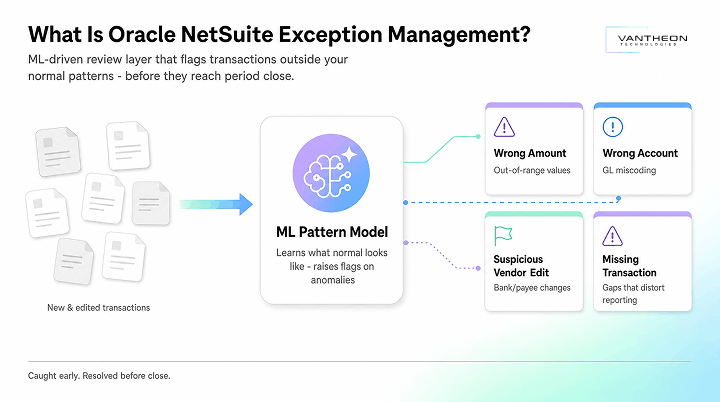
Oracle NetSuite Exception Management is a built-in feature that uses machine learning to identify transactions that fall outside an organization’s normal patterns. It reviews newly created and edited transactions, flags likely errors such as incorrect amounts or accounts, highlights suspicious vendor information changes, and surfaces transactions that appear to be missing before they distort financial reporting.
Rather than relying on static rules or fixed thresholds, Exception Management builds a model of what a business’s transactions typically look like and raises a flag when something breaks that pattern. This directly answers a common question finance teams ask: what is exception management in NetSuite? It is an automated review layer sitting on top of everyday transaction entry, designed to catch problems before they reach period close.
Why Finance Teams Need Exception Management
Finance teams need exception management because manual transaction review does not scale with growing transaction volume, and errors that slip through are far more expensive to fix after month-end close than before it. Automated detection catches the kind of issues a busy reviewer is likely to miss.
Manual Transaction Reviews Are Time-Consuming
Reviewing every invoice, journal entry, and vendor bill line by line is not realistic once transaction volume grows past a certain point. Finance staff ends up sampling transactions rather than reviewing everything, which means genuine errors can pass through unnoticed.
Unusual Transactions Can Be Difficult to Spot
A transaction that looks fine on its own, such as a bill for a slightly higher amount than usual, may only look wrong when compared against months of prior activity. This is exactly the kind of pattern-based anomaly that is hard for a human reviewer to catch quickly, but straightforward for a model trained on historical data.
Financial Errors Can Affect Month-End Close
An incorrect amount or misclassified account discovered after the books are closed usually means reopening a period, adjusting entries, and explaining the variance to auditors or management. Catching these errors while transactions are still fresh avoids this entire chain of rework.
Vendor Information Changes Can Create Risk
Unauthorized or unexpected changes to vendor bank details are a well-known fraud vector. Exception management flags these changes so finance teams can confirm them before a payment goes out, rather than after funds have already left the business.
Missing Transactions Can Distort Financial Reporting
When an expected recurring transaction, such as a monthly rent payment or a regular vendor invoice, does not appear on schedule, it can understate expenses or liabilities for the period. Identifying these gaps early keeps financial statements accurate.
Growing Multi-Entity Businesses Increase Complexity
The challenge compounds for organizations with multiple subsidiaries, multiple currencies, and high transaction volumes, which describes a large share of established businesses across the UAE and Saudi Arabia. Many of these organizations manage multiple legal entities across free zones and mainland jurisdictions, deal in more than one currency across regional and international operations, process significant transaction volumes across procurement, sales, and intercompany activity, and run layered, multi-step approval processes for payments and journal entries.
Regional finance teams are often responsible for VAT-related accounting processes in the UAE and, for Saudi entities, ZATCA e-invoicing compliance, adding another layer of accuracy requirements on top of routine transaction processing. Businesses split across multiple business units or cost centers face the added task of keeping exception review consistent across every division. This is where NetSuite for finance teams in the UAE becomes particularly valuable, since it centralizes exception detection across every entity and currency rather than leaving each unit to manage the task independently.
How Oracle NetSuite Exception Management Works
Oracle NetSuite Exception Management works through a four-step process: it learns from historical transaction data, analyses patterns in that data, detects transactions that fall outside those patterns, and presents them to the finance team for review and resolution. The entire cycle runs automatically once the feature is enabled.
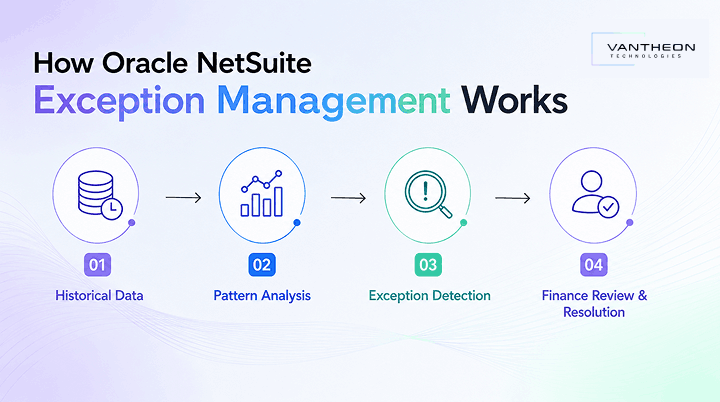
Oracle has confirmed that the feature learns from up to the previous 18 months of transaction activity for each organization, and it reviews newly created or edited transactions on an hourly basis to identify activity that appears out of pattern. Each customer’s model is trained only on that customer’s own data, so the patterns it learns are specific to one organization and are never shared with other NetSuite customers.
1. Learns Normal Transaction Patterns
The system builds a customer-specific machine learning model using up to 18 months of historical transaction data. This gives it a working understanding of what typical amounts, accounts, and vendor activity look like for that particular business, which directly answers how NetSuite detects anomalies: it compares new activity against a model trained on the organization’s own transaction history.
2. Identifies Unusual Activity
Every hour, the system reviews transactions that were created or edited in the previous hour and compares them against the learned pattern. Transactions that deviate meaningfully, such as an unusually high invoice amount or a bill posted to an unexpected account, are flagged as potential exceptions.
3. Provides Context for Review
Flagged exceptions are not left as a bare alert. Each one is presented with supporting context explaining why it was flagged, along with a short list of similar transactions that were not flagged, giving the reviewer a direct point of comparison before deciding on next steps.
4. Finance Teams Resolve or Dismiss Exceptions
Reviewers can open the underlying transaction, correct it and mark the exception resolved, or mark it as no action needed if the transaction is confirmed to be correct. Both actions feed back into the model, helping it refine future detection and reduce false positives for that organization over time.
What Types of Exceptions Can Oracle NetSuite Identify?
Oracle NetSuite Exception Management organizes flagged items into two categories: transaction errors and expected transactions. Together, these cover incorrect amounts, incorrect accounts, suspicious vendor changes, missing transactions, and predicted transactions expected in the days ahead.
Incorrect Amounts
Transactions posted with amounts that fall well outside the typical range for a similar transaction type or vendor are flagged for review, catching data entry mistakes and duplicate charges before they affect reporting.
Incorrect Accounts
When a transaction is coded to an account that does not match the pattern normally seen for that type of activity or vendor, the system raises it as a likely misclassification, which is a common answer to the question Can NetSuite detect incorrect transactions.
Vendor Information Changes
Changes to vendor details, particularly banking information, are flagged so finance teams can verify the change is legitimate before processing a payment against it. Administrators can control which of these changes are surfaced through Exception Management preferences.
Missing Transactions
The system identifies gaps where a recurring transaction, based on established patterns, appears to be missing. This addresses how NetSuite handles missing transactions: for supported transaction types, users can create the expected transaction directly from the exception, and for other types, the system directs them to the correct process page.
Predicted Transactions
Beyond flagging what is missing, the system also surfaces transactions it expects to occur in the next few days of the current accounting period, based on established recurrence patterns, giving finance teams advance visibility rather than a reactive alert after the fact.
How Finance Teams Resolve NetSuite Exceptions
Resolving a NetSuite exception follows a practical five-step workflow: identify the exception, investigate the underlying transaction, correct it if needed, resolve or dismiss the exception, and monitor for similar patterns going forward.
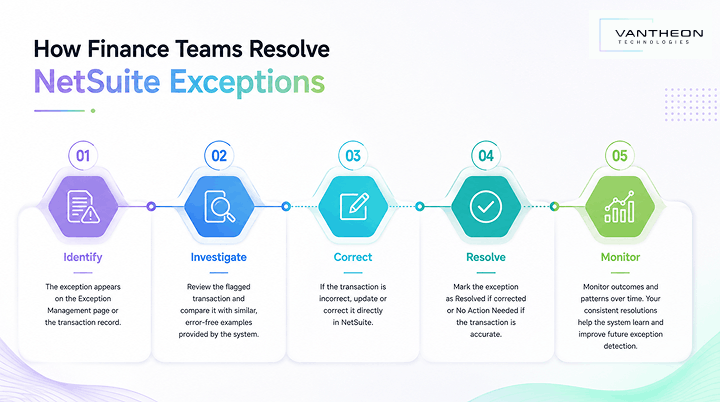
The exception first appears on the Exception Management page or directly on the transaction record itself. From there, the reviewer investigates by comparing the flagged transaction against the similar, error-free examples the system provides. If the transaction is genuinely incorrect, the reviewer corrects it directly and marks the exception resolved. If the transaction is confirmed accurate despite being flagged, it can be marked as no action needed. Over time, consistent resolution activity trains the model to better reflect that organization’s actual patterns, which is the practical answer to how finance teams can automate exception management: by using the tool consistently so its future detection becomes more precise.
Oracle NetSuite Exception Management vs Manual Financial Exception Handling
The core difference between automated and manual exception handling is coverage and consistency. Manual review depends on sampling and staff availability, while Oracle NetSuite Exception Management reviews all qualifying transactions on an hourly basis, at scale, without requiring a reviewer to first suspect something is wrong.
Manual processes also rely on individual judgment, which varies between reviewers and can miss subtle pattern shifts that only become visible when compared against months of historical activity. An automated model applies the same learned pattern consistently, and it improves with feedback rather than depending on the experience level of whoever happens to be reviewing transactions that day. This is the essential distinction underlying ERP exception handling as a discipline: moving detection from a manual, judgment-based task to a systematic, pattern-based one.
Benefits of Financial Exception Management Software
Financial exception management software delivers measurable operational benefits for finance teams, from faster error detection to stronger audit readiness, by shifting review from a reactive, manual task to a proactive, automated one.
Faster Exception Detection
Hourly review of new and edited transactions means issues surface within the same business day rather than during a month-end scramble.
Reduced Manual Review
Finance staff spend less time scanning full transaction lists and more time focused on the specific items the system has already identified as worth a closer look.
Better Financial Controls
Automated vendors change detection and incorrect account flagging add a consistent control layer that does not depend on a reviewer happening to notice something unusual.
Improved Month-End Close
Catching errors as they occur, rather than discovering them during close, reduces the number of late adjustments and reopened periods.
Greater Visibility into Unusual Activity
Finance leaders gain a clear, centralized view of flagged activity across the organization instead of relying on individual team members to escalate concerns.
Better Risk Prioritization
Exceptions are organized and presented with context, allowing teams to focus first on the items most likely to represent a genuine issue.
Improved Audit Readiness
A documented trail of flagged, reviewed, and resolved exceptions gives auditors clear evidence that financial controls are being actively applied, not just designed on paper.
More Efficient Finance Operations
Together, these improvements free up finance team capacity for analysis and decision support rather than routine transaction policing.
Oracle NetSuite Exception Management for Finance Teams in the UAE
UAE finance teams benefit from Exception Management largely through the accuracy it brings to VAT-related accounting and multi-entity reporting. Businesses operating across free zone and mainland structures often process high transaction volumes across several legal entities, and automated exception detection helps confirm that VAT-relevant transactions are captured correctly and consistently across all of them.
For organizations managing regional headquarters alongside branch operations, centralized exception review also means finance leadership does not need to depend on each branch team catching issues independently. NetSuite for finance teams in the UAE becomes a shared, consistent control layer across the whole organization rather than a patchwork of local review practices.
How NetSuite Exception Management Supports KSA Finance Operations
Saudi Arabian businesses operating under ZATCA e-invoicing requirements need financial data that is both accurate and defensible. Exception Management supports this by flagging incorrect amounts, misclassified accounts, and missing transactions before they work their way into VAT filings or e-invoicing submissions, reducing the risk of compliance issues traced back to a simple data entry error.
For KSA organizations running multiple business units or subsidiaries, the same hourly detection cycle applies across every entity connected to the account, giving finance teams in Riyadh, Jeddah, or Dammam a consistent way to catch issues regardless of which unit generated the transaction.
Oracle NetSuite Exception Management and Financial Controls
Exception Management strengthens financial controls by adding an automated, pattern-based review layer that works alongside existing approval workflows rather than replacing them. It does not remove the need for segregation of duties or approval hierarchies, but it does add a systematic check that catches issues those processes were not specifically designed to detect, such as a transaction that was approved correctly but still falls outside normal patterns for that vendor or account.
This directly supports the answer to how exception management improves financial controls: by catching pattern-based anomalies that rules-based approval workflows are not built to identify on their own.
Exception Management vs Reconciliation vs Approval Workflows
These three functions work together but serve different purposes. Approval workflows control who can create or authorize a transaction before it is recorded. Reconciliation confirms that recorded balances match external sources, such as bank statements, after the fact. Exception Management sits between the two, reviewing transactions after they are recorded but before period close, specifically looking for pattern-based anomalies that neither approval routing nor standard reconciliation is designed to catch.
A transaction can pass through a correct approval chain and still be flagged by Exception Management if the amount or account differs meaningfully from established patterns. Used together, all three create a layered financial control environment rather than relying on any single check.
What Should Businesses Look for in Financial Exception Management Software?
Businesses evaluating financial exception management software should look for a solution that trains on their own historical data rather than generic industry benchmarks, reviews transactions frequently enough to catch issues before period close and provides clear context for each flagged item rather than a bare alert. Customizable thresholds and the ability to exclude specific transaction types of matter for organizations with unique or seasonal transaction patterns.
It is equally important that the software improves through user feedback, so that dismissing or resolving exceptions genuinely refines future accuracy rather than treating every review as a one-off task. For multi-entity organizations across the UAE and KSA, the ability to apply consistent exception detection across every subsidiary and currency from a single platform is a practical requirement rather than a nice-to-have.
How Vantheon Technologies Can Help with Oracle NetSuite Exception Management
Vantheon Technologies helps UAE and Saudi businesses configure and get real value from Oracle NetSuite Exception Management, from initial setup and preference configuration to training finance teams on how to review, resolve, and act on flagged exceptions consistently.
Our team works with multi-entity organizations to ensure Exception Management is applied correctly across every subsidiary, currency, and business unit, so exception detection supports VAT and ZATCA-related compliance rather than adding a disconnected process on top of existing workflows. We also help finance teams connect exception management into their broader financial controls, alongside approval workflows and reconciliation processes already in place.
Want to make your NetSuite finance operations more proactive? Talk to Vantheon Technologies about optimizing NetSuite Exception Management and broader financial automation.
Best Practices for Implementing Exception Management
Organizations getting started with Exception Management should first confirm they have enough consistent historical transaction data, since the model performs best with a stable pattern to learn from over time. It helps to review exceptions promptly and consistently rather than letting them accumulate, since regular feedback through resolving or dismissing exceptions is what sharpens the model’s future accuracy.
Setting sensible minimum amount thresholds and excluding transaction types that are not relevant to financial risk keeps the exception list focused on items worth a reviewer’s time. Finally, assigning clear ownership, so a specific person or team is responsible for reviewing exceptions on a regular schedule, prevents the feature from becoming another unmonitored dashboard.
Conclusion
Oracle NetSuite Exception Management gives finance teams a practical way to catch incorrect amounts, misclassified accounts, suspicious vendor changes, and missing transactions before they affect financial reporting. For organizations across the UAE and Saudi Arabia managing multiple entities, currencies, and regional compliance requirements, this kind of automated, pattern-based review adds a consistent control layer that manual sampling simply cannot match at scale. Configured well and reviewed consistently, it turns exception handling from a reactive month-end task into an ongoing part of daily financial operations.
Ready to Strengthen Your NetSuite Financial Controls?
Want to make your NetSuite finance operations more proactive? Talk to Vantheon Technologies about optimizing NetSuite Exception Management and broader financial automation.
Schedule a Demo with our NetSuite specialists to see how Exception Management can fit into your finance workflows.
Beyond Exception Management, Vantheon Technologies supports the full NetSuite lifecycle for businesses across the UAE and KSA, including:
NetSuite Consulting to align NetSuite’s financial controls with your compliance and reporting needs
NetSuite Implementation for organizations setting up NetSuite for the first time
NetSuite Integration to connect NetSuite with your existing finance and banking systems
NetSuite Customization to tailor exception thresholds, workflows, and approvals to your business
NetSuite Support Services for ongoing managed support after go-live
NetSuite Mobile ERP to keep finance approvals and reviews moving while your team is on the move
Whatever stage of your NetSuite financial controls journey you are at, Vantheon Technologies is ready to help you move forward with confidence.
FAQ Section
What is Oracle NetSuite Exception Management?
Oracle NetSuite Exception Management is a built-in feature that uses machine learning trained on an organization’s own historical transaction data to identify transactions that fall outside normal patterns, including incorrect amounts, incorrect accounts, suspicious vendor changes, and missing transactions.
How does Oracle NetSuite identify financial exceptions?
It builds a customer-specific model using up to 18 months of historical transaction data, then reviews newly created or edited transactions every hour, comparing them against learned patterns and flagging activity that appears out of the ordinary.
What types of transactions can Oracle NetSuite Exception Management flag?
It can flag incorrect amounts, incorrect accounts, vendor information changes, missing transactions, and predicted transactions expected in the next few days of the current accounting period, across more than thirty transaction types.
How does Oracle NetSuite Exception Management help finance teams reduce manual work?
Instead of reviewing every transaction manually, finance teams only need to review the specific items the system has already flagged as unusual, with supporting context and comparison examples included for each one.
Is Oracle NetSuite Exception Management available to all NetSuite customers?
The feature depends on sufficient data volume and model training readiness, so it is not automatically available to every customer. Businesses that cannot access it should contact their NetSuite account manager for guidance on next steps.
How can UAE and Saudi businesses use Oracle NetSuite for financial exception management?
UAE and Saudi businesses can use Exception Management to catch errors before they affect VAT filings or ZATCA e-invoicing submissions, apply consistent review across multiple subsidiaries and currencies, and reduce the manual burden on regional finance teams managing high transaction volumes.

Leave a Reply